There is something about job hunting in Spain that still catches my attention.
The photo.
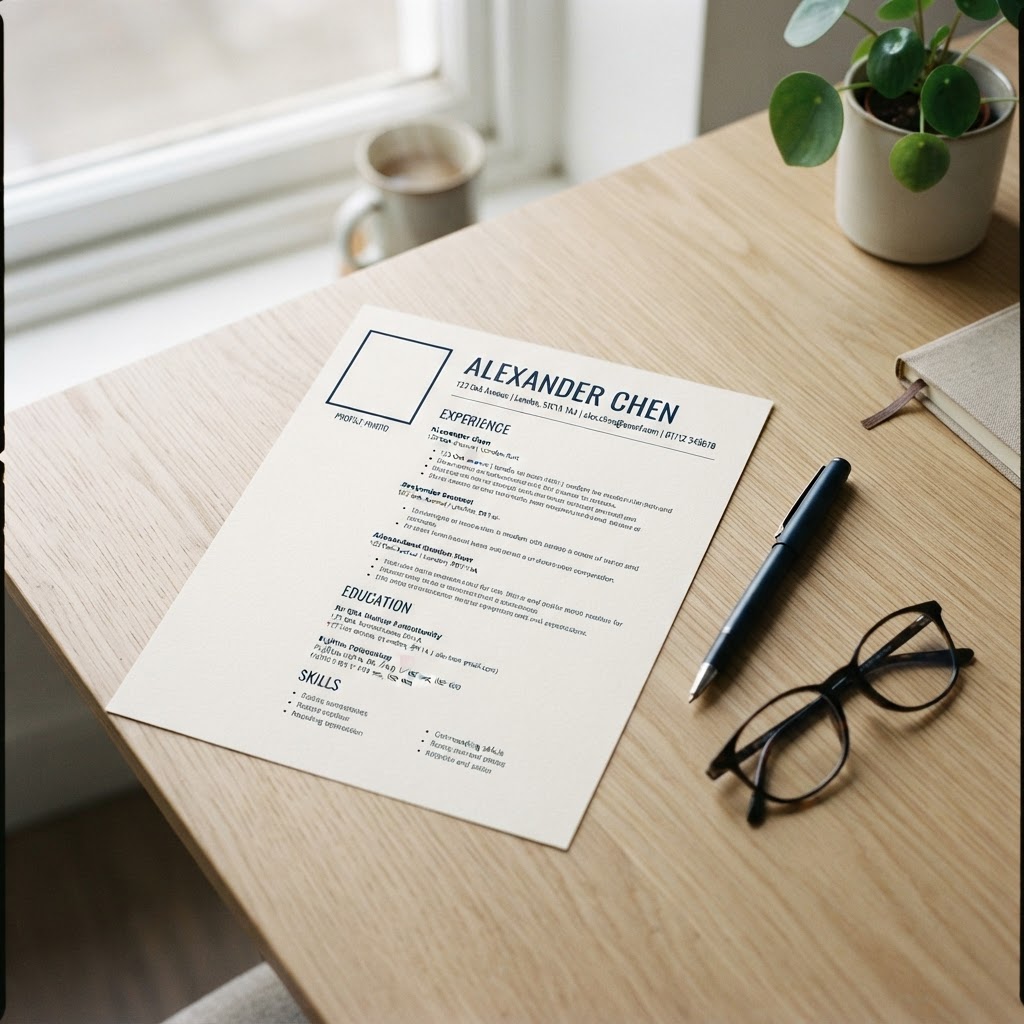
Open enough CV templates and there it is: a professional headshot in the top corner. Smart clothes. Neutral background. Friendly smile.
After spending years living and working in Australia, where I became used to CVs without photographs, moving into the European job market made me notice the difference straight away.
And the more I think about it, the more I come back to the same question:
Why does an employer need to see my face before deciding whether my experience is worth reading?
What is the CV actually supposed to do?
A CV has very limited space.
Ideally, every part of it should help answer a few important questions:
What have you done?
What can you do?
What results have you achieved?
And could those skills help solve the problem this organisation is hiring for?
A photograph answers none of those questions.
It tells the recruiter roughly what I look like.
That is information they will discover soon enough if I reach an interview.
It should not decide whether I reach one.
Australian guidance reflects this approach quite clearly. NSW Government career guidance recommends a simple, easy-to-read CV and advises applicants not to use images unless an employer asks for them.
Spain is less clear culturally, but even here the formal position is changing. Current European employment guidance for Spain says that attaching a photograph is not compulsory.
So why does the practice remain so common?
“But a photo makes the CV more personal”
I understand this argument.
Hiring is human.
People hire people, not just lists of keywords.
In roles involving clients, sales, partnerships, hospitality or stakeholder relationships, how someone communicates and presents themselves genuinely matters.
I have spent much of my career in people-facing roles. I would never argue otherwise.
But there is a difference between assessing someone’s professional presence and assessing their photograph.
A CV photo does not tell you whether someone listens well.
It does not show whether they can manage a difficult conversation.
It does not tell you whether they will follow up after a meeting, earn a client’s trust, coach a struggling colleague or stay calm when something goes wrong.
It gives you a face.
And once we see a face, we are not always as objective as we like to think we are.
We already carry enough bias into recruitment
Age.
Gender.
Race.
Perceived nationality.
Attractiveness.
Disability.
Body type.
Religious or cultural appearance.
Even whether someone looks like our unconscious idea of the kind of person who normally performs a particular job.
A photograph puts several of those signals in front of the recruiter before the candidate has said a word.
This does not mean recruiters are deliberately discriminatory.
Often, the more uncomfortable truth is that bias does not need to be deliberate.
Human beings form impressions quickly.
That is exactly why I question whether we should introduce information unrelated to competence any earlier than necessary.
If two people have similar experience, I would much rather begin by comparing what they have actually done.
And once we see a face, we are not always as objective as we like to think we are.
I’ve seen hiring from more than one side
Over the years, I have been the person applying for jobs, the person responsible for recruitment outcomes, and the person hiring and managing people in my own businesses.
Those experiences have made me more interested in what actually predicts whether someone will work well in a role.
It is rarely the polished surface.
Some candidates interview beautifully but struggle once they have to deliver.
Others may not immediately fit the expected image of the ideal candidate, but turn out to be dependable, adaptable and excellent with people.
That is why evidence matters.
What did you improve?
What problem did you solve?
How did you work with other people?
What happened because you were there?
Those questions tell me far more than a headshot ever could.
Then there is the international candidate
This matters even more when people move between countries.
When you are an international candidate, your CV already carries signals.
Your name may suggest where you come from.
Your universities may be overseas.
Your previous employers may be unfamiliar.
Your English or Spanish may not be your first language.
Your career path may not follow the neat local pattern a recruiter expects.
Add a photograph and there is one more opportunity for someone to make an assumption before understanding your story.
I know what it feels like to move between labour markets and explain experience gained somewhere else.
A role that makes perfect sense in Australia may need more explanation in Spain.
A qualification may be understood differently.
An organisation that everyone knows on the Gold Coast might mean nothing to a recruiter in Madrid, Berlin or Amsterdam.
That is already enough translation for an international candidate to manage.
Their face should not need translation too.
This doesn’t mean appearance never matters
Context matters.
There are jobs where casting, modelling, performance or other appearance-related requirements genuinely exist.
And there are markets where photographs are still culturally expected.
I am not pretending those realities disappear because I dislike them.
Nor am I suggesting people should ignore local recruitment norms if including a photo materially improves their chances of being considered.
The practical advice and the principle can be different.
The practical advice might be:
Understand the market you are applying in.
The principle, for me, is:
We should be moving away from CV photographs unless appearance is genuinely relevant to the work.
Those two ideas can exist together.
Personal branding doesn’t require putting your face on your CV
There is also a slightly strange contradiction in modern recruitment.
We have more ways than ever to understand a candidate as a person.
LinkedIn exists.
Portfolio websites exist.
Video interviews exist.
Personal websites, presentations, articles, recommendations and professional social profiles exist.
I have an online portfolio precisely because a two-page document cannot show the complete picture of who I am professionally.
If an employer wants to understand my background, the projects I have worked on, how I think, the recommendations people have written about me or, yes, what I look like, that information can be available elsewhere.
But the CV has a different job.
It should earn the next conversation.
That is why I would rather give those few centimetres at the top of the page to something useful:
a strong professional summary,
a relevant achievement,
a key capability,
or simply more white space so somebody can actually read the thing.
Perhaps the CV needs to become boring again
We keep trying to make CVs more visually impressive.
Headshots.
Graphs.
Rating bars.
Icons.
Colours.
Skill percentages.
Sometimes they look fantastic.
But recruiters are not hiring the design.
They are trying to answer one question quickly:
Should I speak to this person?
A clear CV that makes evidence easy to find might be more useful than a beautiful CV that makes the candidate easy to see.
So yes, I think the CV photo is overdue for retirement.
Not because people don’t matter.
Exactly the opposite.
Because there is much more to a person than what can fit inside a small circle in the top-right corner of a page.
Show me what you have done first.
We can meet the person afterwards.